The craft
How Blue Man Group makes music: tubes, drums and no words
The look, the silence and the homemade instruments behind a show that tells its jokes through rhythm, with each claim tied to a written source.
Choose a show date ↗Quick answer
Blue Man Group performers are painted blue, stay silent and appear in groups of three. The music comes from drums and from tube instruments the founders say they first built in a living room. Wikipedia lists themes such as technology, innocence and information overload, which is why a show without words still has things to say.
The look: blue, bald and silent
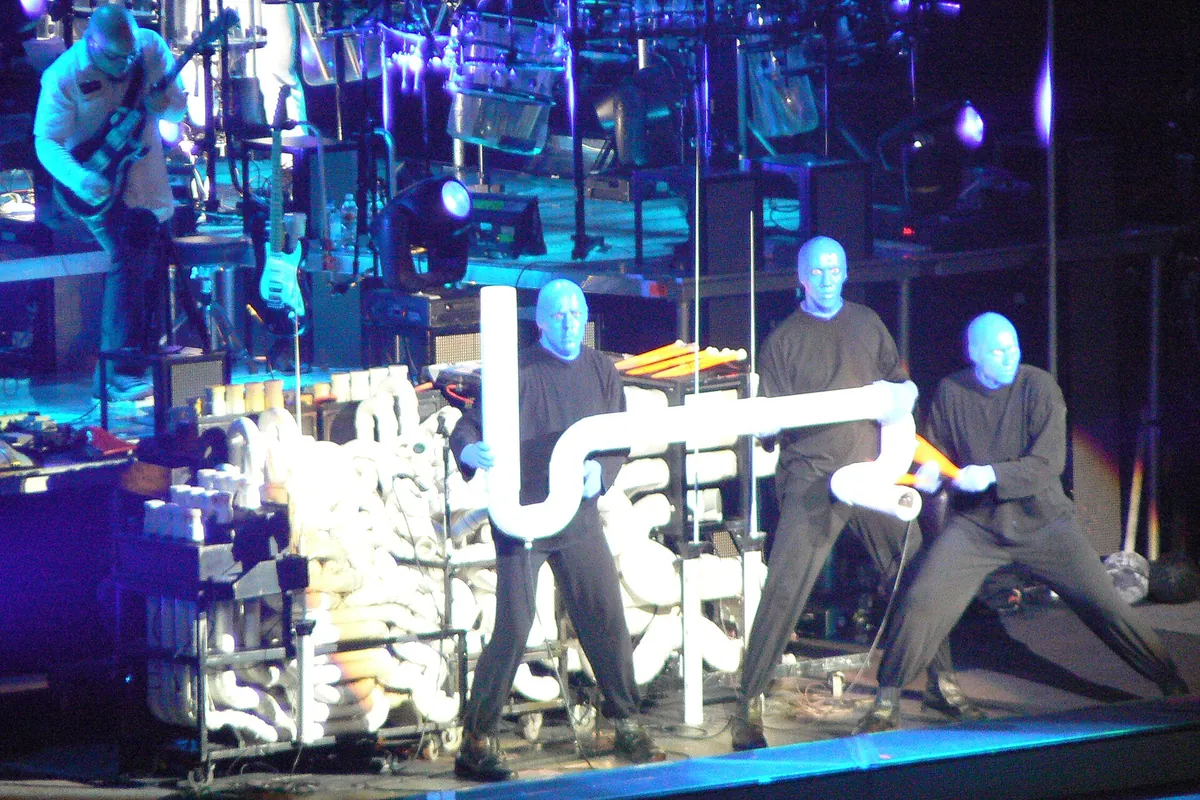
Wikipedia describes performers whose skin is painted blue, who are mute during shows and who always appear in groups of three. Early performers, the article says, learned to embody six archetypes, including the innocent, the scientist and the trickster. The result is three identical-looking figures who can still play different characters, because every change of mood has to be read from posture, timing and expression. The format is constrained on purpose, and the constraint is what makes the comedy work.
Tubes and drums
A 2006 public-television documentary, as Wikipedia summarises it, has the founders describing how they built drums and tube instruments in their living room. Wikipedia's article on PVC notes that plastic piping is a cheaper alternative to metal tubing for instrument making and gives the thongophone, a tube instrument played by slapping, as an example. The group's 2016 album names inventions such as the Snorkelbone, the Chimeulum and the Pipeulum. A drum, in Wikipedia's definition, is a membranophone, an instrument with a stretched skin that is struck, and the booking page promises drums among its ingredients.
Paint and light
The listing mentions drums, paint and light, which is all it says about the visual side. This guide therefore stays with that wording: expect a show in which colour and illumination are part of the music rather than a backdrop to it. Wikipedia's article reports television appearances in which blue paint was used in comic ways, but those are not the stage show, so they are not evidence of what happens at the Luxor. Treat the paint as a promise from the booking page and a reason to dress practically.
Themes under the noise
Wikipedia lists recurring themes: technology, including plumbing and the internet; information overload; innocence, as when the performers seem puzzled by everyday objects; and the clumsy imitation of social customs, such as staging a formal dinner for an audience member. A show without words can carry those ideas because they are visual and physical. If you enjoy reading meaning into a performance, the themes give you something to chew on. If you do not, the drumming and the jokes stand on their own.
What the format asks of you
A silent show asks the audience to pay attention to faces, hands and rhythm. It also asks you to accept that you may be drawn in, since reviewers mention audience interaction. The booking page gives no detail, and nobody can promise whether you will be picked. Go expecting a concert crossed with comedy, not a play, and you are likely to enjoy the match. Go expecting a plot and you may find it thin.
Why timing carries the jokes
When nobody speaks, a joke depends on the beat before it lands: a pause, a stare, a hit on a drum. That is why percussion sits at the centre of the act and why the three performers move in step. Visitors who enjoy rhythm-led comedy of any kind tend to like the form, because the pleasure comes from timing rather than from a script. The booking page sums the Luxor version up as comedy, music and art, with drums, paint and light.
Frequently asked questions
Do the performers ever speak?
Wikipedia describes them as mute during shows.
Are the instruments really made of plumbing?
The founders describe building tube instruments at home, and Wikipedia notes plastic piping as a cheap instrument material. The booking page does not describe the instruments.
Sources
- Booking page for the Luxor show (read 18 November 2026)
- The performers, their archetypes and the albums, per Wikipedia's Blue Man Group article
- PVC piping and instrument making, per Wikipedia's Polyvinyl chloride article
- Drums as membranophones, per Wikipedia's Percussion instrument article
- Performance art as a genre, per Wikipedia's article